Failure-To-Yield Fault Turns On Right-Of-Way And The Evidence After The Crash
An Oklahoma car accident caused by a driver who fails to yield can happen in seconds. One vehicle enters an intersection or turns across traffic. Another driver has little or no time to react. What follows is often a dispute over who actually had the right of way.
Oklahoma law establishes specific duties at stop signs, yield signs, intersections, left turns, and private driveways. But proving that another driver violated one of those rules can require much more than simply pointing to where the crash occurred.
Our Oklahoma car accident lawyers at Lawter & Associates investigate these collisions throughout Oklahoma City, Tulsa and across the state. When two drivers give conflicting accounts, physical evidence, video, witnesses and the official accident report can become critical to establishing who should have yielded.
A Stop Sign Requires More Than Simply Stopping
Under Oklahoma Statute Title 47, Section 11-403, a driver approaching a stop sign must stop and then yield to a vehicle that has already entered the intersection or is approaching closely enough to create an immediate hazard.
That second requirement matters. A driver doesn't necessarily satisfy the law by coming to a complete stop and then immediately pulling forward. The driver still has to determine whether approaching traffic is close enough that entering the intersection would be unsafe.
Yield signs work somewhat differently. A driver must slow to a reasonable speed and stop if necessary, then yield to pedestrians legally crossing the roadway and to vehicles already in the intersection or approaching closely enough to create an immediate hazard.
Oklahoma law even provides that, in certain circumstances, a collision after a driver passes a yield sign without stopping can serve as prima facie evidence that the driver failed to yield.
Failure To Yield Happens In Several Common Situations
Stop signs are only one place where right-of-way disputes arise. Oklahoma's traffic laws impose yielding duties in several situations, including:
- Left Turns: A driver turning left generally must yield to approaching traffic that is close enough to create a hazard. These left-turn collisions can be especially dangerous when a driver misjudges the speed or distance of an approaching vehicle.
- Stop-Controlled Intersections: A driver may stop, but then pull into the path of traffic already with the right-of-way.
- Yield-Controlled Intersections: A driver may enter without slowing enough to determine whether another vehicle or pedestrian is approaching.
- Private Roads And Driveways: Oklahoma law generally requires a driver entering a highway from a private road or driveway to yield to vehicles already approaching on that highway.
The existence of a traffic violation can be strong evidence, but fault still depends on the circumstances of the collision. The fact that one driver violated a right-of-way rule doesn't necessarily prevent the other driver from being assigned some percentage of responsibility.
The Driver With The Right-Of-Way Can Still Share Fault
Consider a driver who pulls away from a stop sign directly in front of an approaching vehicle. The first driver may have clearly failed to yield. But suppose the approaching driver was traveling well above the speed limit while looking at a phone.
Those additional facts can affect how responsibility is divided.
That matters because Oklahoma uses modified comparative negligence. Under Title 23, Section 13 of the Oklahoma Statutes, an injured person isn't barred from recovery unless their negligence is greater than the negligence attributed to the person or combined parties who caused the damage.
So a person found 20% responsible could still recover, but their damages would generally be reduced by 20%. A person found 50% responsible can still potentially recover against a defendant who is also 50% responsible, with the recovery reduced accordingly. Once the injured person's fault is greater than the opposing fault, recovery can be barred.
This makes fault percentages particularly important in a disputed failure-to-yield case. An insurer may accept that its driver made a mistake at the intersection while still arguing that speeding, distraction, or another action by the injured driver contributed to the collision.
Video Evidence May Exist Even Without A Red-Light Camera
A camera can sometimes settle a right-of-way dispute quickly, but families shouldn't assume every Oklahoma intersection has footage available.
Oklahoma doesn't generally use red-light cameras. Instead, video of an Oklahoma car accident may come from other sources, including nearby businesses, residences, toll road cameras, vehicle dash cams, or witnesses who recorded the collision.
That creates a practical problem: privately owned footage may not be kept for long. A business security system may automatically overwrite old recordings, and a homeowner or witness has no obligation to preserve a video indefinitely simply because a crash occurred nearby.
Finding potential cameras early and requesting that relevant footage be preserved can therefore make a significant difference when the drivers disagree about who entered the intersection first.
The Police Report Can Help Reconstruct The Right-Of-Way
The official Oklahoma Traffic Collision Report can contain several useful pieces of information in a failure-to-yield case.
An Oklahoma accident report may identify citations, witnesses, contributing factors, driver actions, and the investigating officer's diagram and narrative of the collision.
The report isn't necessarily the final word on legal fault, but it can preserve details that become harder to reconstruct months later.
For example, an officer may document:
- The location of stop or yield signs.
- Where each vehicle entered the intersection.
- Statements made by the drivers and witnesses.
- Whether a traffic citation was issued.
- Skid marks, debris and final vehicle positions.
- Road, weather and visibility conditions.
Reviewing the report for errors is important. A mistaken diagram, incorrect direction of travel or incomplete witness information can create unnecessary problems once an insurance company begins evaluating fault.
Vehicle Damage Can Help Test Competing Stories
Physical evidence can also help determine whether the drivers' accounts make sense.
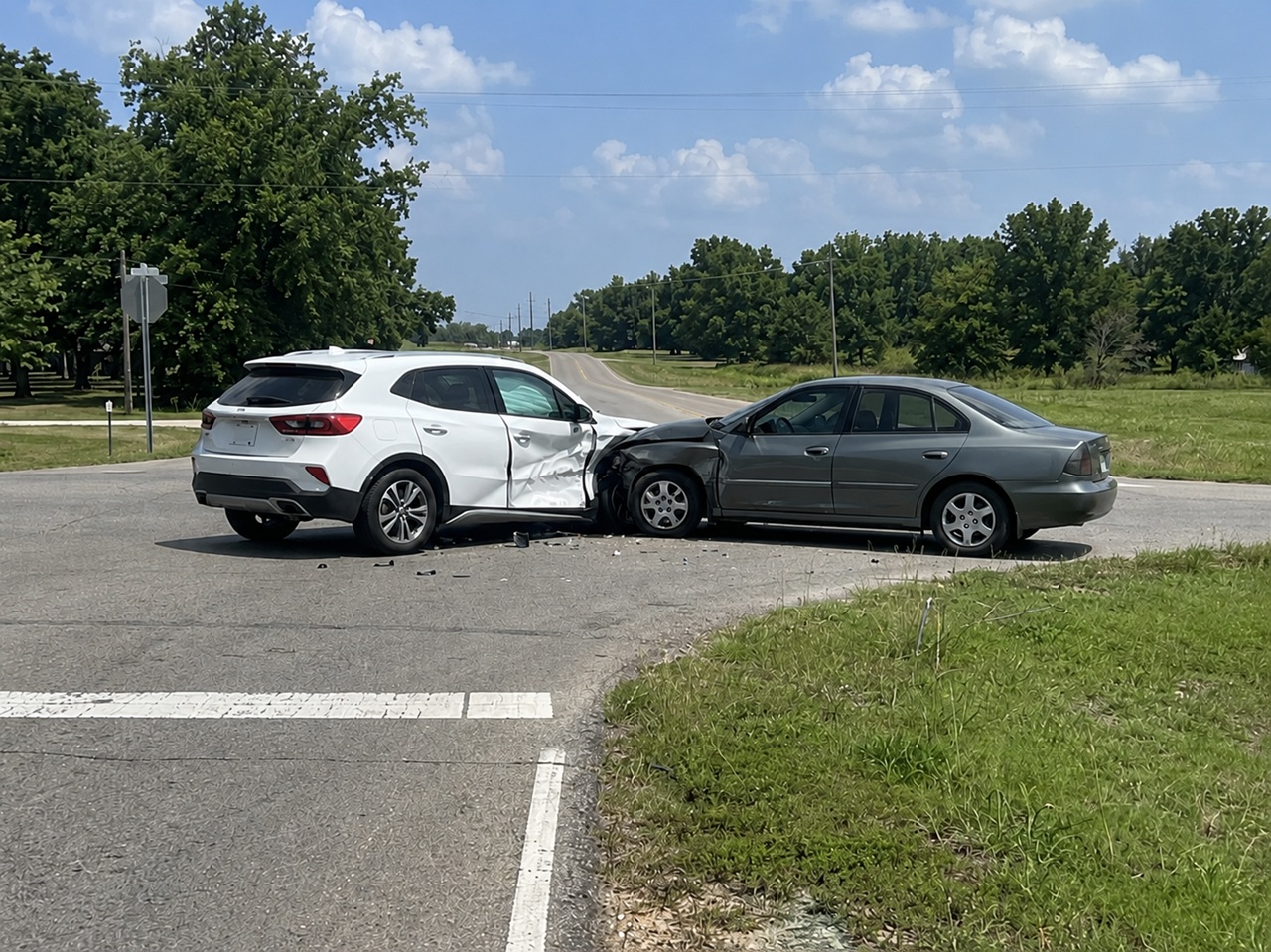
A T-bone impact to the side of one vehicle may support an account of how the vehicles entered an intersection, but damage location alone doesn't automatically establish right-of-way. Investigators may also consider the angle of impact, debris, tire marks, final resting positions, and available vehicle data.
That's why taking photographs after an Oklahoma car accident can be valuable. Pictures should capture more than a close-up of the damaged bumper. Wider photographs showing the intersection, traffic controls, sightlines, lane markings, and vehicle locations can preserve information that may disappear once the cars are removed.
Many newer vehicles may also store data concerning speed, braking, or other vehicle activity before a collision. Depending on the seriousness of the crash and the issues in dispute, that information may become another way to test whether a driver's account is consistent with the physical evidence.
Oklahoma Imposes Additional Consequences For Serious Failure-To-Yield Crashes
The state treats some failure-to-yield violations especially seriously.
Under Oklahoma Statute § 11-403.1, a driver convicted of failing to yield and causing a fatality or great bodily injury can face an additional $500 assessment. Courts may also impose other consequences allowed by the statute, including a remedial driving course, a 90-day driver's license suspension, or restitution.
Those traffic penalties are separate from an injured person's civil claim for medical expenses, lost income, and other losses caused by the collision.
A Stop-Sign Case Shows Why The Evidence Matters
Lawter & Associates recovered $122,000 for a client after a defendant ran a stop sign and T-boned the client's vehicle on US 270 near Seminole. The impact sent the client's vehicle on top of the defendant's overturned pickup truck and caused injuries to the neck, back, and head, along with lacerations that ultimately involved surgery.
That result doesn't establish what another failure-to-yield case will be worth. But it illustrates how a relatively familiar traffic violation can produce significant injuries and a substantial claim when the evidence establishes what happened.
The value of compensation after an Oklahoma car accident depends on factors such as medical expenses, lost income, future treatment needs, pain and suffering, available insurance, and any percentage of comparative fault assigned to the injured person.
Our Oklahoma Car Accident Attorneys Can Investigate Who Had The Right-Of-Way
A failure-to-yield case can become difficult quickly when each driver insists the other entered the intersection improperly. Our Oklahoma car accident attorneys can examine traffic controls, obtain the crash report, locate witnesses, review available video, and preserve physical and electronic evidence before it disappears.
We can also challenge an insurance company's efforts to shift an unfair percentage of fault onto you. Even seemingly harmless statements after a crash can become part of that argument, which is why it's important to be careful what you say after an accident.
If another driver failed to yield and caused your injuries, contact us for a free case evaluation. We can review the evidence, explain how Oklahoma's right-of-way and comparative-negligence laws may apply, and discuss your options for pursuing compensation.
"This accident was one of the scariest and emotional things I have been through in years. They made everything go so smoothly that at times I forgot I was even in an accident. I will recommend them to everyone. Great Job!!!!!" - Zechariah B., ⭐⭐⭐⭐⭐