
Several Drivers, Several Insurance Companies, and One Question Every Injured Person Needs Answered
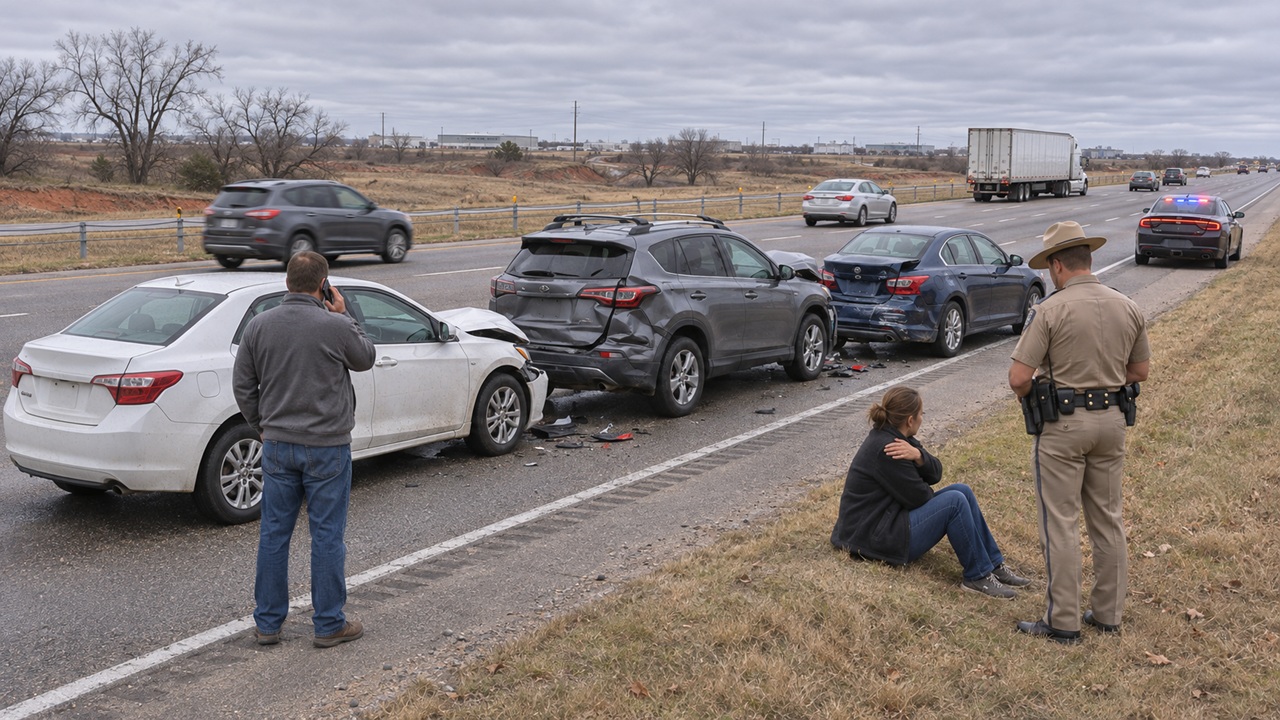
Chain-reaction pileups on Oklahoma highways can involve a dozen vehicles or more in a matter of seconds. On July 17, 2026, a crash shut down eastbound I-44 at the Adair exit on the Will Rogers Turnpike. The Oklahoma Highway Patrol (OHP) said 15 to 20 vehicles were involved, according to News On 6. Crashes like that one leave many people hurt and confused about what happens next.
In a pileup, every driver tends to blame someone else. So does every insurance company. A driver who was rear-ended may hear that the car ahead stopped too fast. The insurance company may also say the driver behind should pay. Injured people often end up stuck in the middle while the arguments drag on.
Sorting out who caused each impact takes careful work, and the sooner it starts, the better. At Lawter & Associates, PLLC, our Oklahoma car accident lawyers gather the evidence, identify every responsible driver, and push each insurance company to pay its fair share.
|
Pileup Claims at a Glance
|
How Chain-Reaction Pileups Happen on Oklahoma Roads
Most pileups start with one sudden change. A driver brakes hard, a vehicle loses control, or traffic stops without warning near a construction zone. Drivers following too closely don't have time to react, and the impacts start to stack up. One crash can quickly turn into several.
Weather makes it worse. Fog can cut visibility to almost nothing. Ice on bridges and overpasses can send cars sliding before drivers know what's happening. Oklahoma's busy interstates, including I-35, I-40, and I-44, also carry heavy truck traffic. A loaded semi needs far more room to stop than a passenger car.
These crashes happen fast, and many drivers can't say exactly what hit them or when. Some vehicles are struck more than once by different drivers. That confusion is exactly why pileup claims need careful investigation before anyone accepts the insurance companies' version of events.
How Fault Gets Sorted Out in a Multi-Car Crash
Investigators and lawyers start by asking who set the crash in motion. The driver who caused the first impact often carries a large share of the blame. That's not the end of the analysis. Drivers who crashed into the growing pileup may also be responsible.
Following distance is a major factor. Oklahoma law requires drivers to leave a reasonable and prudent distance between their vehicle and the one ahead. Drivers must also keep a speed that's safe for the conditions, even if it's below the posted limit. In fog or on ice, a driver who keeps going the speed limit may still be driving too fast.
The order of impacts matters, too. Picture a driver who stopped safely and was then rear-ended. That claim looks very different from one by a driver who slid into the car ahead first. Crash reports, OHP diagrams, damage patterns, dashcam video, and vehicle data recorders can help piece together the sequence. Understanding how to read your Oklahoma accident report is a good first step.
How Oklahoma's 50% Rule Works in a Pileup
Oklahoma follows a modified comparative negligence rule under 23 O.S. § 13. An injured person can recover compensation as long as his or her fault isn't greater than the other side's. Any award is then reduced by the injured person's percentage of fault.
Pileups add an important twist. Oklahoma's law compares the injured person's fault against the combined fault of the other drivers. It doesn't compare drivers one at a time. Suppose an injured driver is 40% at fault and two other drivers are 30% each. The injured driver can still recover, since 40% isn't greater than the combined 60%.
Insurance companies know how this rule works, and they use it. Each one may try to push more blame onto the injured driver to cut what it pays. Strong evidence about following distance, speed, and the order of impacts can keep the blame where it belongs.
Each Driver Usually Pays Only His or Her Own Share
Oklahoma generally doesn't make one at-fault driver pay for another's share of the blame. Since a 2011 change to state law, each responsible party usually pays only its own percentage of fault. Suppose one driver is 60% at fault and another is 40%. Each typically pays only that portion of the total.
That rule creates a real risk in pileups. If one of the responsible drivers has no insurance or very little, part of the compensation may go unpaid. The other drivers' insurance companies generally won't cover that missing share.
That's why identifying every driver who played a role is so important. Missing even one responsible party can leave money on the table. A thorough investigation looks at every vehicle, every impact, and every policy that might apply.
Who May Share the Blame in a Pileup
Every pileup is different, but certain drivers tend to share responsibility. Here's how fault often breaks down and what evidence helps prove it.
| Driver's Role | How They May Be at Fault | Evidence That Helps |
|---|---|---|
| Driver Who Triggered the Crash | Sudden braking, losing control, or causing the first impact | Witness statements, dashcam video, OHP report |
| Tailgating Driver | Following too closely to stop in time | Damage patterns, vehicle data recorders |
| Driver Going Too Fast for Conditions | Speeding in fog, ice, or heavy traffic | Weather records, skid marks, speed data |
| Commercial Truck Driver | Unsafe following distance, fatigue, or speed | Electronic logs, truck data, company records |
| Injured Driver | Often blamed unfairly by insurance companies | Proof of safe speed and a full stop before impact |
A single pileup can involve several of these roles at once. Each insurance company will push its own version of events. Building an accurate picture of what happened, impact by impact, protects an injured person's right to full compensation.
When There Isn't Enough Insurance to Go Around
Oklahoma's minimum liability coverage is $25,000 per person and $50,000 per crash. That may sound like a lot until several people are hurt by the same driver. In a pileup, all of those injured people may have to share one driver's $50,000 limit. Serious injuries can use it up quickly.
An injured person's own policy may help fill the gap. Uninsured and underinsured motorist (UM/UIM) coverage can pay when the at-fault driver doesn't have enough insurance. Medical payments coverage can help with early bills. Commercial truck policies usually carry much higher limits. That's one reason truck accidents need prompt investigation.
Juggling several claims with several insurance companies at once is complicated. Each company has its own adjusters, deadlines, and tactics. A lawyer can coordinate every claim and track down all available coverage. That way, no source of payment gets overlooked.
Steps to Take After a Pileup
The evidence in a pileup can disappear quickly as vehicles are towed and the road is cleared. These steps help protect an injured person's health and claim.
- Get Medical Care – Neck, back, and head injuries don't always show symptoms right away, and medical records document the harm.
- Get the Crash Report Number – Ask the trooper or officer for the report number so the full report can be requested later.
- Photograph Every Vehicle – Capture where each car ended up, the damage, skid marks, and the road conditions.
- Note the Weather – Record fog, ice, rain, or glare, since conditions often play a role in pileups.
- Collect Information From Every Driver – Get names, phone numbers, and insurance details from everyone involved, not just the car that hit you.
- Look for Video – Dashcams, nearby businesses, and traffic cameras may have captured the crash.
- Avoid Other Drivers' Insurance Companies – Don't give statements or sign anything, and send all contact to a lawyer.
Oklahoma generally allows two years to file a personal injury lawsuit. In a pileup, though, that time can disappear quickly while several insurance companies trade blame. Talking with a lawyer early keeps the evidence fresh and protects every possible claim.
We Know How to Make Things Right When Everything Goes Wrong
Lawter & Associates, PLLC has represented injured people throughout Oklahoma since 1974, with offices in Oklahoma City and Tulsa. We charge no fee unless we win your case. We handle property damage free for injury clients. We'll also never take more of your pretrial settlement than you do.
Our case results include an $890,000 mediation award for a client rear-ended by a tow truck on Highway 9. They also include a $550,000 settlement for a client rear-ended by a semi-truck in Northwest Oklahoma. We keep every client informed from start to finish.
Caught in a pileup and getting the runaround from insurance companies? Let us sort it out with a free case evaluation.
"Highly recommended! Heather, Ashley and the entire team were easy to work with, kept me informed and always answered any questions that I had. You won’t be disappointed in the professionalism of this team." — Jennifer Y., ⭐⭐⭐⭐⭐