
March is Brain Injury Awareness Month, and it's a good time to shed light on the risks drivers face in a crash. The skull is dense, curved, and built to take a beating. But the brain inside it is a different story. Soft, floating, moving on its own schedule, it doesn't always get the memo that the rest of your head stopped moving. That gap, brief as it sounds, is where a lot of serious injuries are born.
Most people still picture brain injury as a hard hit, a visible wound, a dramatic moment of impact. What they don't picture is the person who walks away from a rear-end crash feeling shaken but intact, only to spend the next six months struggling to read, sleep, or remember where they put their keys. No head hit, no bump, and no bruise. Yet, there's very real damage.
Understanding how that's possible matters, whether you're trying to make sense of your own symptoms, support someone who's been in a car accident, or simply make better decisions after a traumatic event.
What actually happens to the brain when the body is jolted?
Think of your brain like a yolk suspended inside an egg. The shell, like your skull, can stay completely intact. But shake that egg hard enough and the yolk moves, collides with the inside of the shell, and tears. The protective container held. The contents didn't.
Your brain floats in cerebrospinal fluid, which cushions it from minor bumps and jostles. That fluid is helpful in everyday life. When your head snaps forward and then rebounds, your brain keeps moving in the original direction for a fraction of a second longer than your skull does. It slides forward, strikes the interior wall, then bounces back and can hit the opposite side. Doctors call this a coup-contrecoup injury, and it explains why some patients show bruising on two completely opposite sides of the brain from a single event.
What's even more damaging, in many cases, are the shearing forces created by rotational motion. Different layers and regions of the brain move at slightly different speeds during a twist or spin. The nerve fibers, called axons, that connect these regions get stretched and torn. This is known as diffuse axonal injury, and it's one of the most common forms of traumatic brain injury. It can happen across a wide area of the brain simultaneously, disrupting communication between regions in ways that don't necessarily show up on a standard CT scan.
How can a car accident cause brain injury without the head hitting anything?
You don't need a dramatic collision or a blow to the skull for the brain to sustain serious damage. Any car accident that causes the head to whip, snap, or rotate suddenly can generate enough force to injure brain tissue, even if nothing ever makes contact with your head. Some of the most common personal injury scenarios where this happens include:
- Rear-end car collisions: The body is held by the seatbelt, but the head snaps forward and rebounds freely, which generates powerful rotational forces across the brain.
- Side-impact and T-bone crashes: The sudden lateral jolt can cause the head to twist sharply to one side, shearing the nerve fibers that connect different brain regions.
- Slip and fall accidents: The body drops, stops abruptly, and sends the unsupported head into a rapid snap or jolt, even if it never strikes the ground or a surface.
- Pedestrian and bicycle accidents: The force of a vehicle strike or a sudden stop can throw the body and cause violent head movement without direct head contact.
- Workplace accidents: Falls from height or sudden equipment-related jolts, with mechanics similar to vehicle crashes.
- Blast and explosion exposures: These are common in industrial accidents and construction incidents, where pressure waves pass through the skull and compress brain tissue in milliseconds, with no physical contact.
- Sports and recreational collisions: Deceleration forces or rotational motion during a tackle, fall, or collision can cause injury even without helmet-to-helmet impact.
Why do these injuries so often go undiagnosed?
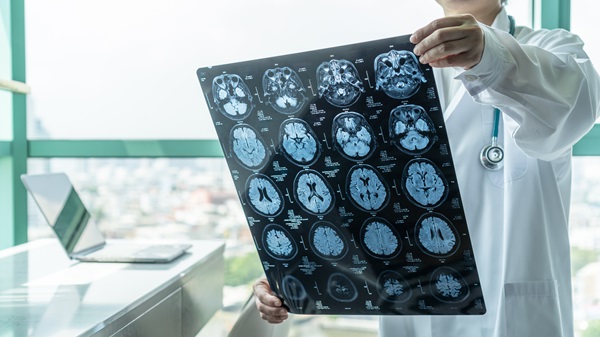
Part of the answer is imaging. Standard CT scans, the most commonly used diagnostic tool in emergency settings, are very good at detecting bleeding, fractures, and large structural damage. They're not good at detecting diffuse axonal injury or the subtle cellular changes that follow a concussion. Most patients who've had a real brain injury leave the emergency room with a normal-looking scan and very little guidance about what to watch for next.
More advanced imaging, like diffusion tensor imaging, can reveal white matter damage that standard MRIs miss entirely. But it isn't routinely used in emergency departments, and most people never get referred for it.
Symptoms that are easy to explain away
Symptoms add another layer of confusion. The most common signs of a non-contact brain injury include:
- Persistent headaches, mental fog, and difficulty concentrating
- Fatigue and disrupted sleep that doesn't resolve with rest
- Mood changes, irritability, or heightened sensitivity to light and noise
These overlap with anxiety, depression, burnout, and a dozen other conditions. When there's no visible head trauma and no alarming scan, it's easy for both patients and doctors to chalk them up to stress or the general shock of being in a car accident.
The adrenaline delay
Adrenaline complicates things further. In the hours after a traumatic event, the body's stress response can mask or suppress early symptoms entirely. Many people genuinely feel fine at first. When the fog rolls in a day or two later, they've already mentally disconnected it from the crash, and so has everyone around them.
You deserve a fighter in your corner, not a form letter
The insurance company already has a team of adjusters and lawyers working to reduce what they pay you. You deserve the same level of firepower on your side. Lawter & Associates has spent more than 40 years fighting for injured Oklahomans across Tulsa, Oklahoma City, and communities throughout the state, including Cleveland, Canadian, Comanche, Rogers, Payne, Wagoner, Pottawatomie, Creek, Muskogee, Garfield, Grady, and Washington counties. We dig deeper than the police report, we don't flinch when insurance companies push back, and we don't stop until you have everything you're owed.
Best of all, getting started costs you nothing. Our consultations are completely free, and we work on a contingency-fee basis, meaning we only get paid if we recover compensation for you. If you've been injured in a crash and you're not sure where to turn, turn here. Contact us anytime to schedule your free case consultation. The sooner you call, the sooner we get to work.
"Outstanding job. Thank you, Mary, Tim, and the whole crew. Will be traveling through in the near future and looking forward to seeing ya'll. It's a good day." - William, ⭐⭐⭐⭐⭐